
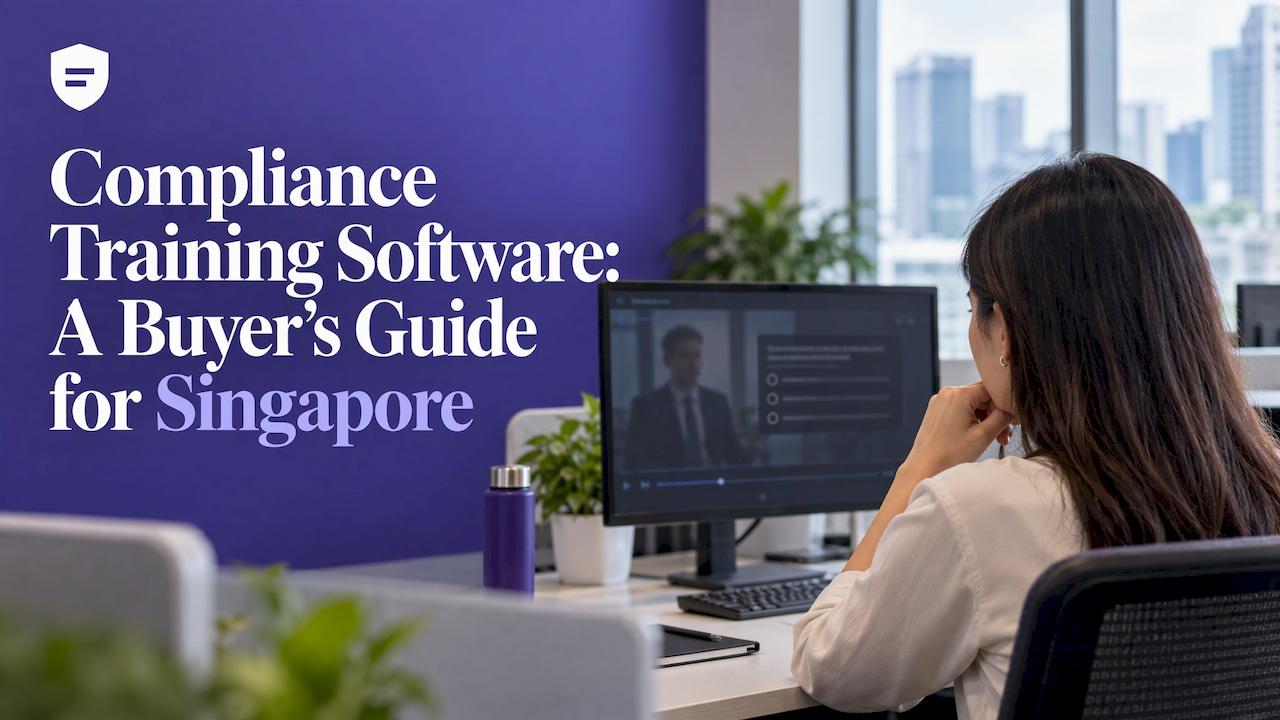
Compliance training software delivers mandatory training to employees online and keeps a record of who completed it. For a regulated Singapore firm, the best software goes one step further. It shows that people understood the rules that apply to your organisation, not only that they clicked through to the end. Solvere's interactive film modules pause to test learners on your own compliance issues and record every answer, so your audit file holds evidence of comprehension rather than attendance.
This guide is for compliance officers, heads of risk and HR teams who have to choose a platform. It explains what the software does, which Singapore expectations it has to meet, which features matter and how to judge whether training is working.
TL;DR
- Compliance training software assigns courses, tracks completion and stores records. Good platforms also test understanding question by question.
- MAS guidelines expect firms to train staff adequately and to review whether that training is adequate. Completion alone does not answer that.
- Look for content tied to your own policies and regulatory notices, per-person answer records, version control and exportable audit reports.
- Solvere builds film-based modules that pause to test learners and records every interaction, with clause-level coverage mapping and exportable audit records.
- Judge success by behaviour and knowledge gaps found, not by a 100% completion rate.
Table of Contents
- What compliance training software does
- Why Singapore firms need more than a completion log
- The types of compliance training you can run online
- Features that matter when you compare platforms
- Measuring whether training works
- How Solvere approaches compliance training
- How to choose: a short process
- Making training engaging for employees
- FAQ
- Sources
What compliance training software does
At its simplest, compliance training software does four jobs:
- Delivers training online to employees, whether on a laptop in the office or a phone at home.
- Assigns it to the right people, usually by role, team or entity, and sends reminders.
- Assesses what each person has learned through quizzes, scenarios or tests.
- Records the results so that the firm can show a regulator, an internal auditor or a board what was done.
Search results for this term are full of general learning platforms with a compliance tab. Those are built to host any course on any subject. A platform built for compliance treats the record as the product: who was trained, on which version of which content, when, and how well they answered.
This matters most to the readers who search for "online compliance training for employees". Employees want a short, clear module that respects their time. Compliance officers want proof. Good software gives both, because a module that engages people is also one that produces meaningful answers.
Why Singapore firms need more than a completion log
If you work in a Singapore financial institution, training is not a courtesy. It sits inside the rules you are supervised against.
For banks, the Monetary Authority of Singapore (MAS) says in its guidelines to Notice 626 on money laundering and terrorism financing (revised 18 October 2024) that a bank should adequately train its employees and officers on their AML/CFT obligations. The same document says final accountability rests with the board and senior management. Training is therefore a governance matter, not just an HR task.
Finance companies face a similar standard. The guidelines to MAS Notice 824, dated 1 July 2025, say a finance company should monitor how adequate its staff training and awareness are, and that internal audit should evaluate how effective the training is.
The key words are adequacy and effectiveness. A log that says "98% completed" tells an auditor nothing about either. A record that shows which questions each person answered, where they got stuck and which policy clause the question tested gives you something to defend.

What MAS found in a recent review
MAS published a thematic review of four financial institutions' recruitment and onboarding training covering 2024 to 2025. Among the good practices it noted were modules with quizzes of varying complexity, and online programmes with time controls that require a minimum duration on each module before the assessment opens. Among the poor practices were letting representatives advise on products before they had completed the relevant training, and not reviewing third-party training materials.
Three lessons follow for anyone choosing software:
- Assessment should be built into the module, not bolted on at the end.
- The platform should stop people skipping ahead.
- You should be able to review what the content says against your own policies, including content you did not write.
CPD hours and record-keeping for licensed representatives
Some roles carry hour-based requirements as well. Under MAS's fit and proper guidelines, every appointed representative of a financial adviser must complete structured continuing professional development (CPD) relevant to their work and keep evidence of the hours. The Institute of Banking and Finance (IBF) explains on its SFA CPD page that holders of a Capital Markets Services licence and exempt financial institutions need 6 core hours in Ethics or Rules and Regulations plus 3 supplementary hours, and that only IBF-accredited courses count towards the core hours. The same page says that since 1 January 2019 a principal entity must total each representative's structured CPD hours at the end of every calendar year, keep a register, and retain it for at least 5 years from the end of the calendar year in which the representative was appointed.
Private banking has its own scheme. IBF's CACS CPD FAQ states that Covered Persons need at least 15 CACS CPD hours a year, including at least 8 hours of IBF Standards Training Scheme-accredited training and at least 4 hours of Rules and Regulations, Compliance or Ethics training. Records must show course name, date, activity type and hours, Designated Representatives report fulfilment by 31 January each year, and IBF may audit entities and report to MAS.

Two practical points follow. First, check which of your obligations are hour-based and need accredited courses, because an in-house module will not necessarily count towards them. Second, whatever software you choose must hold dates, hours and activity types in a form you can export on request. Confirm the current rules with MAS and IBF before relying on any figure above, since schemes are revised.
The types of compliance training you can run online
The training that suits an online format tends to fall into three groups.
Policy and rule awareness. Code of conduct, conflicts of interest, information barriers, anti-money laundering, sanctions, data protection and whistleblowing. These benefit from consistency: every employee sees the same content and answers the same checks.
Role-specific obligations. Front-office staff need different scenarios from operations, HR or senior management. A relationship manager facing a suspicious transaction needs a different module from a finance clerk reviewing an invoice.
Refreshers and updates. When a notice changes or an incident occurs, you need to push a short module to the affected people quickly, and prove they have taken it.
Many firms combine online modules for the core rules with live sessions for discussion of grey areas. That is a sound pattern, and the online part works best when it feeds the live part: if the platform shows that a third of a team misjudged the same scenario, the live session knows where to spend its time.
Features that matter when you compare platforms
Most vendor pages list the same features: reminders, certificates, dashboards. Those are table stakes. These are the ones that separate software that protects you from software that only fills a spreadsheet.
| Feature | Why it matters | What to ask |
|---|---|---|
| Content tied to your policies | Generic courses teach generic rules. Your regulator examines your own procedures. | Can the module reflect our policy wording and the notices that apply to us? |
| Assessment inside the content | Questions that appear in context show understanding as it forms. | Does the learner have to answer before the module continues? |
| Per-person answer records | Shows who struggled with what, not only who finished. | Can I see each answer, not a single score? |
| Content versioning | Proves staff were trained on the policy in force at the time. | Is each record linked to a content version and date? |
| Coverage mapping | Shows which regulatory clause or policy section each question covers. | Can I see coverage by clause? |
| Exportable audit records | Auditors and regulators ask for evidence in a usable form. | Can I export records by person, team, topic and date range? |
| Assignment and reminders | Keeps completion on schedule without chasing. | Can I assign by role and entity? |
A practical test applies to every row: could you hand the output to an internal auditor without explaining it? If the answer needs a long caveat, the feature is weaker than it looks.
Records that stand up to an audit
The records you need are straightforward to list. For each person, you want the content version they received, the date it was assigned and completed, the answers they gave and the resulting score. For the programme as a whole, you want completion rates by team, the questions most often answered wrongly, and an export you can place in your compliance file.
Version linking deserves particular attention. If your anti-money-laundering procedures changed in March and an employee was trained in January, the record should show that. Otherwise you cannot show that training reflected the policy in force when it was needed.
For anti-money-laundering training, Singapore firms should also confirm their retention period against the MAS notices that apply to them, since record-keeping obligations are written into them.
Measuring whether training works
Completion tells you that people spent time. It does not tell you what they took away. MAS's wording about training adequacy and effectiveness points the same way: firms are expected to look at quality, not just volume.
Four measures give a fuller picture:
- Question-level results. Which scenarios do people get wrong, and are the errors concentrated in one team or role?
- Repeat performance. Do scores improve when a refresher is assigned on the topic?
- Operational signals. After training on a topic such as suspicious transaction escalation, do escalations become more timely or better documented? Your own case data and spot checks answer this.
- Audit findings. Does internal audit find fewer lapses in the areas you trained?
The first two come from the software. The last two come from your own monitoring, and the software's records help you connect them. When a lapse occurs, you can see whether the person answered the relevant scenario correctly, which tells you whether the issue was knowledge, judgement or process.
How Solvere approaches compliance training
Solvere builds compliance training around one idea: evidence of understanding rather than mere attendance. Its modules are film scenarios that pause to test the learner on compliance issues relevant to the organisation, such as information barriers and money laundering. The platform records every interaction, so you can see each person's comprehension and identify knowledge gaps.
The content is mapped to a firm's own regulatory notices and internal policies, with clause-level coverage mapping so you can see which provisions your training addresses. Audit records can be exported when a regulator, auditor or board member asks for evidence.
That matches the pattern in the MAS review: assessment inside the module, tests that vary in demand, and records you can review. It also removes a common weakness of off-the-shelf content, where the course teaches the rule but your own procedure never appears.
Solvere is sold as a subscription to organisations, and the training library is available on the Solvere library page. Pricing is not published.

If you are a compliance officer or head of risk preparing for your next MAS inspection or internal audit, see the Solvere library to find the modules that match your obligations.
How to choose: a short process
- List your obligations. Note the MAS notices and guidelines that apply to your licence, plus any CPD scheme your representatives fall under. Mark which ones require accredited hours.
- Map them to topics and roles. Decide who needs which module and how often.
- Set your evidence standard. Decide what you want to show an auditor: answers, scores, content versions, coverage by clause.
- Review the sample content with your own policy beside it. If the module cannot reflect your wording, staff will learn a rule and then meet a different procedure at work.
- Check the exports. Ask to see the audit record format before you commit.
- Plan the follow-up. Decide how you will use the gap data: targeted refreshers, live sessions or changes to procedure.
Smaller firms without a dedicated compliance team can follow the same sequence in less time. The obligations list is shorter, but the evidence standard is the same.
Making training engaging for employees
People searching for online compliance training for employees often want it to be less tedious. A few design choices help, and they also improve the quality of your records:
- Short modules. Ten to fifteen minutes on one topic is easier to retain than an hour on six.
- Realistic scenarios. A film showing a colleague handling a conflict of interest teaches judgement. A slide listing the policy teaches recall.
- Questions at the moment of decision. Pausing at the point where the character must act makes the learner commit to a choice before seeing the outcome.
- Immediate feedback. The learner learns why an answer was wrong while the scenario is still in mind.
Engaged employees give more honest answers, and honest answers are what make your gap analysis useful.
FAQ
What is compliance training software?
It is a platform that delivers mandatory training on regulations and company policy, assigns it to staff, assesses what they learned and stores the records. In a regulated business, those records are used to show regulators and auditors that employees were trained.
What records should the software keep?
At minimum: who took each module, which version of the content, the date, each answer given and the score. You should be able to export these by person, team, topic and period. Solvere records every interaction and supports exportable audit records.
Does Singapore require training to be online?
The MAS guidelines quoted above require adequate training and, for finance companies, monitoring of its adequacy. They do not tell firms to use any single format. Online delivery is common because it scales across teams and produces records. Hour-based schemes such as IBF's CPD requirements have their own rules on accredited courses, so check them first.
How do I know whether the training is effective?
Look beyond completion. Review which questions people get wrong, whether refreshers improve scores, and whether operational checks and audit findings improve in the topics you trained. MAS expects internal audit to evaluate effectiveness for finance companies, so build that review into your plan.
Can training be tailored to our own policies?
It should be. Solvere maps its modules to a firm's own regulatory notices and internal policies, so learners are tested on the rules and procedures that apply to your organisation.
Sources
- Guidelines to MAS Notice 626 on Prevention of Money Laundering and Countering the Financing of Terrorism (18 October 2024)
- Guidelines to MAS Notice 824 on Prevention of Money Laundering and Countering the Financing of Terrorism (1 July 2025)
- MAS thematic review of FIs' recruitment and onboarding training of representatives
- IBF: SFA CPD requirements
- IBF: CACS CPD frequently asked questions